Top 10 AI News
MIT in the media: 2025 in review
December 22, 2025
MIT community members made headlines in 2025 with significant research advances and efforts to tackle pressing challenges. This year-end media review highlights key stories and accomplishments from MIT’s researchers and programs.
Guided learning lets “untrainable” neural networks realize their potential
December 18, 2025
MIT’s Computer Science and Artificial Intelligence Laboratory (CSAIL) demonstrated a new method that allows even “untrainable” neural networks to learn effectively. By having one network guide another using its inherent biases, the research shows these challenging neural nets can be trained successfully for practical tasks.

A new way to increase the capabilities of large language models
December 17, 2025
Researchers at the MIT-IBM Watson AI Lab developed an expressive neural architecture that significantly improves large language models’ ability to track states and reason sequentially over long texts. Their approach enhances LLM performance on tasks requiring detailed, step-by-step reasoning.

A “scientific sandbox” lets researchers explore the evolution of vision systems
December 17, 2025
MIT researchers designed an AI-powered tool that simulates evolutionary development of vision. This “scientific sandbox” allows scientists to study how changing environments impact the architecture of artificial vision systems, insights that could lead to improved sensors and cameras for robotics and autonomous vehicles.
“Robot, make me a chair”
December 16, 2025
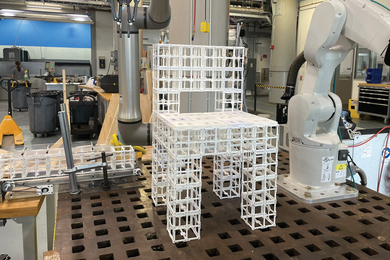
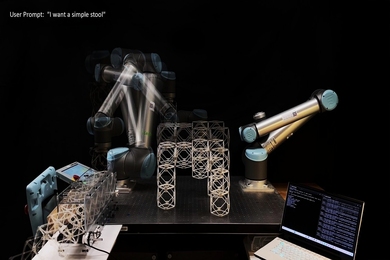
MIT engineers demonstrated an AI-driven system for designing and building simple furniture. Users describe a multi-component object in plain language, and the system generates a digital design which is then constructed by a robotic assembly system. The proof-of-concept shows a chair spontaneously created from user-descriptive commands.

Deep-learning model predicts how fruit flies form, cell by cell
December 15, 2025
A new deep learning model developed by MIT scientists can simulate the cellular development of a fruit fly embryo over time. The model accurately predicts cell movements and shapes as the embryo grows, offering a tool that could eventually help identify early signs of disease in more complex tissues.

Enabling small language models to solve complex reasoning tasks
December 12, 2025
MIT CSAIL researchers introduced a “self-steering” system called DisCIPL that coordinates multiple small language models to work together on constrained tasks. By dividing problems like itinerary planning or budgeting into subtasks, DisCIPL allows lightweight models to collaboratively handle complex reasoning with good results despite their limited individual size.

New MIT program to train military leaders for the AI age
December 12, 2025
MIT announced an Applied AI certificate program tailored for U.S. Navy officers. The curriculum equips military leaders with AI and machine learning skills to address complex defense challenges, signaling an effort to integrate cutting-edge technology literacy into military education.
MIT researchers “speak objects into existence” using AI and robotics
December 5, 2025
MIT and Amazon researchers unveiled a system combining 3D generative AI with robotic assembly. Users describe an object verbally, and the AI generates a 3D design. A robotic arm then automatically fabricates the object. The “speech-to-reality” tool can create small, open lattice furniture pieces on demand from simple text prompts.
Robots that spare warehouse workers the heavy lifting
December 5, 2025
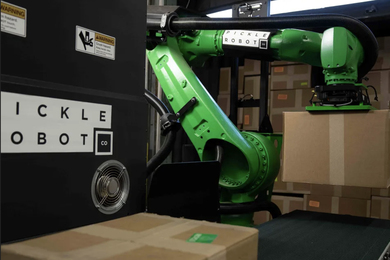
The Pickle Robot Company, founded by MIT alumni, introduced autonomous robots for loading and unloading trucks in warehouses. These robots use suction-based grips to lift heavy items, reducing manual strain on workers. The innovation aims to improve logistics efficiency and worker safety.

US stocks rose again in 2025 after overcoming turbulence from tariffs and Trump’s fight with the Fed
December 23, 2025
After several steep drops driven by concerns over tariffs, interest rates, and an AI-driven market bubble, U.S. stocks finished 2025 at record highs. The year was volatile but ultimately “scary good” for investors as the market rebounded. AI’s impact on market psychology was noted amid other economic uncertainties.

Google’s parent buys data center energy specialist Intersect for $4.75 billion to help power AI
December 22, 2025
Alphabet, Google’s parent company, agreed to acquire data center energy specialist Intersect Power for $4.75 billion. The deal is intended to bolster Google’s clean energy infrastructure for running power-hungry AI data centers, ensuring sustainable energy supply for expanding artificial intelligence services.

Starlink in the crosshairs: How Russia could attack Elon Musk’s conquering of space
December 22, 2025
As Russia looks for leverage in conflicts overseas, analysts warn that Elon Musk’s Starlink satellite network could become a target. The article delves into geopolitical risks facing satellite internet systems, exploring how cyberattacks, satellites’ vulnerability, and national security concerns might disrupt these networks.

The rise of deepfake cyberbullying poses a growing problem for schools
December 22, 2025
Schools are grappling with incidents of students creating and sharing deepfake images of classmates, a new form of cyberbullying. Educators and experts describe cases where AI-generated explicit images have circulated online, raising legal and disciplinary challenges. The article examines the trend’s impact and how schools are responding.

Boys at her school shared AI-generated, nude images of her. After a fight, she was the one expelled.
December 22, 2025
In Louisiana, a middle school student got into a physical fight after classmates circulated AI-generated nude images of her. Shockingly, the girl who was targeted ended up being expelled. The story highlights the emerging problem of using generative AI to create explicit content and the difficulties schools face in handling these cases.

Amazon’s Robotaxi unit launches in San Francisco without steering wheels—Or fees
November 18, 2025
Amazon’s self-driving taxi subsidiary, Zoox, began offering rides in San Francisco in fully autonomous electric vehicles that lack steering wheels, mirrors, or pedals. The ride service is currently free as Zoox continues testing. Co-founder Jesse Levinson indicated the company is close to obtaining regulatory approval for commercial deployment.

Microsoft confronts agent sprawl with Agent 365
November 19, 2025
Microsoft introduced “Agent 365,” a platform designed to manage the proliferation of AI agents. The system helps businesses coordinate and orchestrate hundreds of autonomous AI routines (agents) across Microsoft 365 apps, aiming to streamline workflows and prevent chaotic overlap known as “agent sprawl.”

Gemini 3 approaches the Uber-software point: AI as the new UI
November 18, 2025
With Gemini 3, Google takes a bold step towards making generative AI a general-purpose user interface. Instead of searching with text queries, users can interface with AI as if interacting with an “Uber software” layer over the internet. This marks a shift toward using AI models as front-end interfaces for countless tasks.

In chasing biological efficiency, innovators are turning to “analog”
December 27, 2025
AI developers are exploring biologically-inspired computing approaches to improve efficiency. The article describes how researchers are creating silicon-based hardware that mimics processes found in nature (“analog AI”), aiming to reduce the energy cost of AI computations by leveraging biological design principles.

Successfully living under your means via generative AI
December 27, 2025
Generative AI chatbots and agents can help consumers budget and plan purchases to live below their means. The author explains how using AI tools for intelligent shopping and expense tracking can reinforce financial discipline, allowing people to cut unnecessary spending and improve savings while still enjoying life’s essentials.

Technological disruption: Strategic inflection points from 2026–2036
December 26, 2025
Over the next decade, advances in AI will combine with quantum computing and new connectivity to profoundly transform industries. The article outlines key inflection points—from ubiquitous AI agents to cyber-physical integrations—that will reshape business and society from 2026 through 2036.

Silicon and the business context of AI
December 26, 2025
New hardware developments such as Cerebras’ giant AI chip reflect a shift beyond Moore’s Law. The author discusses how innovations in silicon design are making large AI models more accessible to businesses, enabling enterprises of all sizes to leverage AI in new commercial contexts.

Make 2026 the year you actually learn AI
December 26, 2025
In this advice piece, the author argues that anyone investing time in learning a new skill should focus on AI in 2026. As artificial intelligence continues to transform industries, gaining AI knowledge and skills promises long-term benefits that far outlast other trends.

How 2025 recalibrated AI models’ race
December 26, 2025
The AI community shifted focus in 2025 from raw performance to efficiency and reliability. This article analyzes trends in large language models, noting how improvements emphasize long-form reasoning, lower energy use, and integration into real-world workflows rather than just benchmark-breaking scores.

The Holiday Dissonance: Why AI’s real gift this season isn’t efficiency—It’s permission to protect your sanity
December 26, 2025
This holiday season, the author suggests using AI agents to reduce decision fatigue and give people space for rest. Instead of obsessing over efficiency, relying on AI for routine tasks can free up time and mental energy to enjoy family and relaxation—essentially giving people “permission” to simplify their lives.

How To Rethink Your Job As AI Agents Reshape Work
December 26, 2025
With AI agents automating routine tasks across industries, the author advises professionals on adapting to this change. The article offers guidance for rethinking job roles: focusing on uniquely human skills like critical thinking and creativity, while letting AI handle repetitive or data-driven tasks.

The $40 Billion Healthcare AI Failure — And The EMR Divide Sabotaging Progress
December 26, 2025
Despite massive investment in AI for healthcare, most projects fail to deliver. The author examines how outdated electronic medical record systems (“EMR divide”) and implementation challenges have caused many healthcare AI initiatives to flop, even as only a small fraction of hospitals achieve significant AI-driven improvements.

Google Notebook Rolls Out Lecture Mode With British Flair
December 25, 2025
Google’s experimental NotebookLM AI application introduced two new features: “Audio summaries” that convert notebook pages into quick podcasts, and a forthcoming “Lecture Mode” that automatically summarizes documents in a British-accented voice. These updates make passive learning more interactive via generative AI.

AI Minted More Than 50 New Billionaires In 2025
December 25, 2025
A record year for AI fundraising and startup activity in 2025 propelled dozens of founders and executives into billion-dollar wealth. From high-flying generative AI companies to robotics ventures, the surge in AI investment created more than 50 new billionaires, many of them quite young.
Is The AI Job Apocalypse Real Or Overhyped?
December 25, 2025
While headlines warn of massive AI-driven job losses, the reality for most workers is more nuanced. The author analyzes data from companies implementing AI to show that rather than wholesale unemployment, many jobs are being reshaped. The piece argues that fears of a “job apocalypse” are exaggerated in many sectors.

The Robot Olympics Will Have Zero Sports. Here’s Why
December 24, 2025
Instead of traditional sports events, the upcoming Robot Olympics will feature competitions that reflect everyday robot capabilities — such as assembly, object recognition, and logistics tasks. The article explains that because robots excel at precision and endurance rather than typical athletic prowess, the event focuses on practical challenges like infrastructure repair and manufacturing tasks.